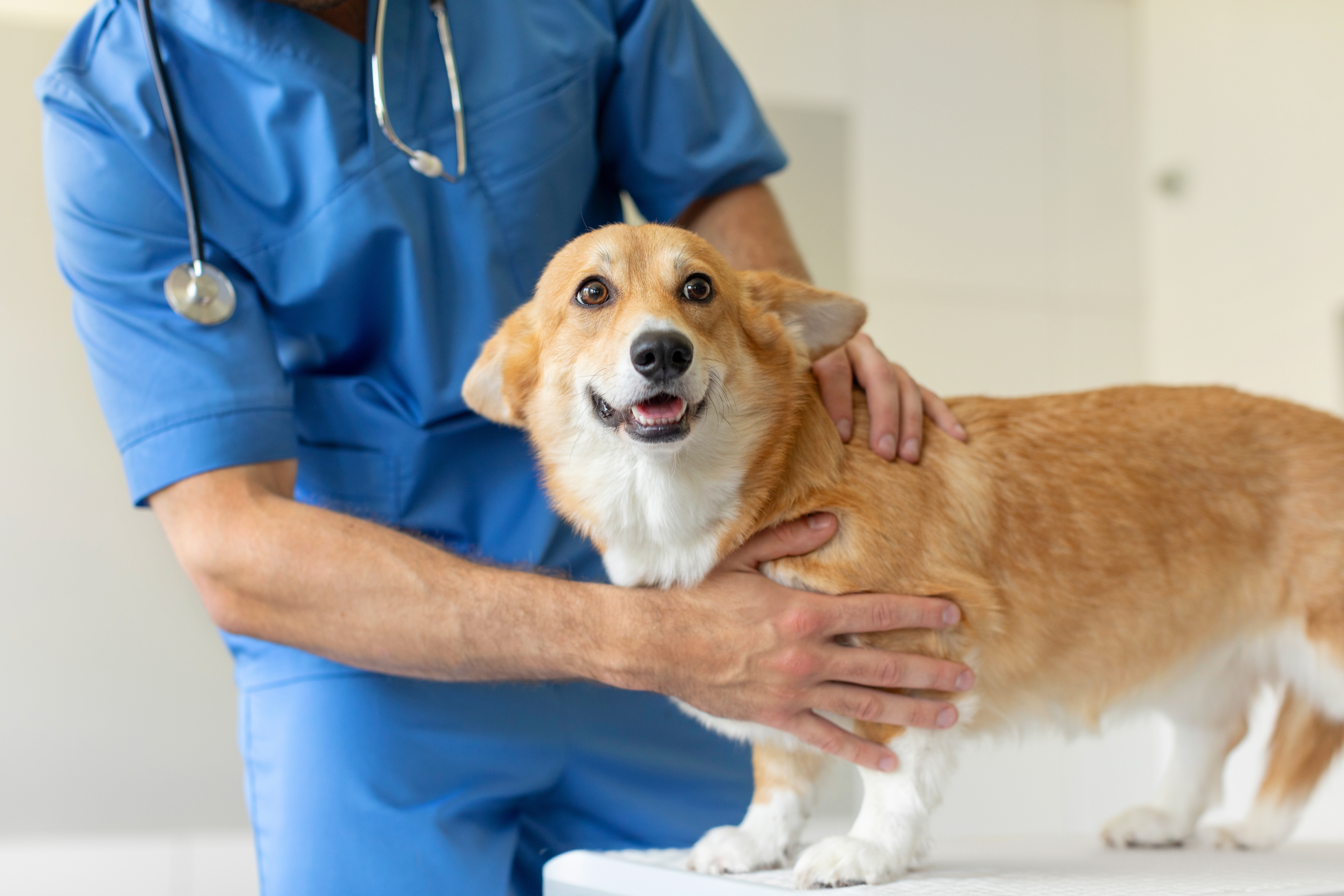
7 Tips for Calmer Vet Visits
Most dogs don't like going to the vet, and who can blame them? Lacking the ability to understand what is happening to them or why, a vet visit must seem much like an alien abduction. Dogs are poked, prodded, pushed into different positions, have fingers inserted into their mouths, ears, and butts, have limbs manipulated - and that's before the really unpleasant stuff like shots and anal gland expressions!
As a trainer with a history of working in vet clinics, I have many years of first hand experience in just how terrified vet visits can make our dogs. It is devastating to watch dogs melt into violently trembling puddles between their owners' legs, become so terrified that they defecate, or channel their stress and anxiety into aggression. All veterinary staff everywhere would agree that extremely stressed-out patients make their job more difficult, more dangerous, and more emotionally exhausting. And all dog owners everywhere would agree that watching our beloved family members enter such stressed-out states is heartbreaking for us. Fortunately, there are ways we as dog owners can make these necessary visits less stressful for everyone involved.
1) Ask your vet for anxiety medications

While anxiety medications aren't going to immediately fix everything, they certainly can help take the edge off your dog's stress. Your vet should be able to recommend and prescribe some medications that will help your dog feel calmer and less acutely anxious during your vet visit.
Always follow your veterinarian's recommendations when it comes to medications. It is important to stick to their prescribed dosing and administration schedule. Veterinarians are considering both your dog's well-being as well as the safety of their staff when they write these prescriptions. Giving too much can cause a dangerous overdose; giving to little might not have the desired effect.
2) Keep your own emotions under control

Dogs are incredibly sensitive to our moods and often look to us to determine whether or not a situation is safe. It can be very easy to fall into a spiral when your dog's anxiety starts ramping up. Often, a vicious feedback loop forms where the more agitated and stressed a dog gets, the more frantic and anxious the owner gets. The owner's agitation feeds the dog's own anxiety, causing even more stress and fear in the dog, and on and on it goes. Or sometimes the owner gets frustrated with their dog for exhibiting stress behaviors like barking or crying. Snapping at your dog, yelling at them to be quiet, jerking on the leash, or other expressions of frustration and anger also only feed into your dog's overall stress levels.
If you feel yourself getting anxious, stressed, or frustrated, take some deep breaths. Remind yourself that your dog isn't being stubborn, bad, or mean. She is just scared. She doesn't need you to yell at her; she needs you to reassure her that she's going to be okay. Slow your breathing down. Lower the tone and volume of your voice. Long, slow strokes down your dog's back can help calm both of you down.
3) Take your dog on "happy visits" to your vet clinic

A "happy visit" is a quick, in-and-out visit to your vet's office with your dog where nothing happens except treats and petting. The goal is to teach your dog that the vet clinic is actually a fun place 99% of the time. At it's most basic, a happy visit can look like a quick stop into the lobby, where reception will give your dog some treats and some attention (if your dog likes that). The goal of a happy visit is to turn the physical space of the vet clinic into somewhere less scary. Your dog walks in, gets some yummy treats and attention, and then leaves again. With enough repetition, your dog should hopefully slowly start feeling more and more comfortable.
Once your dog is dragging you into the lobby for his snacks and snuggles, ask your vet if you can step it up a little. If they have days of the week or times of day where they are less busy, ask if a staff member can bring your dog into the back, or into an exam room for more treats and attention. You'll have to coordinate this with your vet clinic, but most clinics are delighted to participate in happy visits.
Take happy visits at your dog's pace. If he starts trembling when you pull into the parking lot, start there first and work up to the lobby only when your dog is okay in the parking lot.
4) Make sure your dog is comfortable in a crate

While this may not seem related to veterinary care at first, almost every dog is, at some point in his life, going to have to be dropped off at the vet. Whether it's for surgery, a dental cleaning, an emergency visit, or for a routine procedure, just about every dog is unfortunately going to have to spend some time waiting in a cage or run at the vet's office. These drop-offs can already be incredibly stressful for dogs. They are left in an unfamiliar place full of strange and scary smells, sights, and sounds. Other dogs nearby may be barking or crying. They maybe don't feel well or are in pain.
One of the biggest things you as a dog owner can do to make drop-offs easier on your dog is to make sure that your dog is comfortable in a crate. If your dog understands a crate to be a place of peace and safety, she will feel much more relaxed while she waits at the vet's office. Confinement, while necessary and unavoidable, can be the most stressful part of any veterinary visit. Even dogs that love coming to the clinic, who greet everyone with enthusiasm and participate happily in all procedures, sometimes absolutely melt down once confined in a cage.
If your dog has never been crate trained, or if he associates crates with punishment and deprivation, don't worry! It's not too late. By working with a qualified professional, it is possible to overcome your dog's negative feelings surrounding crates. There are a lot of other benefits to crate training besides veterinary visits, and many other situations in which your dog might need to be crated or confined.
5) Desensitize your dog at home to common veterinary tools & procedures
A big part of what can make vet visits so stressful for dogs is unfamiliarity. Exposing your dog to necessary medical and grooming tools and procedures is a vital part of socialization that should continue well past puppyhood. Some items that are frequently encountered in veterinary clinics might include:
Syringes

Stethoscopes
Nail trimmers
Thermometers
Shaving razors
Otoscopes (used to look inside ears)
Q-tips
Vetwrap (used for bandages)
Elizabethan collars (often called cones or e-collars)
Muzzles
Some of these items, like syringes, cones, vetwrap, and q-tips, your vet might be willing to let you take home if you ask. Others, like nail trimmers, you might already have yourself. Familiarize yourself with how these items are used and do some work at home to desensitize your dog to their existence and use. For example, you could briefly touch a syringe (without a needle, of course) to your dog's back and then immediately give her a treat. Then, you could fake giving an injection by picking up some loose skin on the back of your dog's neck, touching the syringe to the skin, and following up with a treat. Your dog will start to associate the sight of the syringe and the motions of the injection with good things.
If you notice that your dog starts displaying anxiety at the sight of some of these objects, take things much slower. Start by just showing your dog the object from several feet away, then toss her a high value treat like hot dog or cheese. Repeat this until she no longer looks as anxious, then move slowly closer. If at any point you notice nervous body language, stop and back up a bit until your dog feels more secure. The goal is to overwrite your dog's negative associations with that particular tool by constantly pairing its presence with good things.

You can and should also desensitize your dog to having every part of her body handled. Start by touching your dog all over and watching her body language as you do. Are there any parts of her body she doesn't like you handling? If so, start pairing quick touches to those areas with high-value treats or toys. It can also be helpful to look up some videos of veterinarian's performing exams or technicians giving injections or drawing blood to see what kinds of handling and restraint is required for the most common procedures.
Desensitization to these procedures can be a long road - especially if your dog already has strong negative emotions associated with certain tools or handling techniques. However, it can make a huge difference in your dog's stress levels in the long run. Even if your dog is unbothered by veterinary tools or items currently, exposing your dog to them now in a fun, positive way can make future vet visits much smoother.
6) Teach your dog cooperative care
Have you ever wondered how vet visits work for zoo animals? In the past, routine veterinary care, even for simple procedures, often required sedation for zoo animals. Recently, however, many zoos have began implementing cooperative care and consent into their animals' routines. This involves teaching the animal behaviors that allow veterinary, grooming, and husbandry procedures to be performed safely while the animal is awake and an active participant. This dramatically lowers stress for the animals and is better for their overall well-being.

For example, at Wolf Park in Indiana, the wolves are trained in a "chin rest" behavior that allows their keepers to perform exams and give injections. This tiger at the Copenhagen Zoo is being trained to present his tail for blood draws, open his mouth so his teeth can be inspected, and move his body around for visual inspection. Tucker the hippo at the Cincinnati Zoo participates in his dental work. If wolves and tigers and hippos can all participate in their veterinary care, there's absolutely no reason our pet dogs can't! Cooperative care training may look or sound intimidating, but if you can teach your dog to sit, you can teach a chin rest just as easily.
But cooperative care doesn't end with just teaching a behavior - that is just the beginning. The power of cooperative care comes from the animal's agency in the situation. In all the videos above, the animals all can leave the situation whenever they choose. The wolf can move his chin off the block. The tiger can pull his tail away from the blood draw. The hippo can close his mouth and leave. Cooperative care is all about giving your dog some agency back in his care. Obviously there will be situations where veterinary care is going to have to happen no matter what your dog thinks about it, but for routine procedures, giving your dog choices can dramatically improve his mental well-being.

How does this work? The principal is very straightforward. As long as your dog is offering the cooperative care behavior (often also called a consent behavior), the procedure or handling can continue. If your dog stops the behavior (ie, moves his chin off a chin rest), the procedure stops as well. Your dog will learn very quickly that her behavior is what determines when thing stop and start.
Cooperative care can be a gamechanger for dogs that feel overwhelmed by routine procedures, but it is a more advanced kind of training. There are plenty of great resources to learn more available online (like this article), but working with a qualified professional trainer can help get you started on what's best for your dog.
7) Stand up for what your dog needs!

You are your dog's voice. You know her best. You know her body language, her moods, and her triggers better than anyone else does. Do not be afraid to let your vet know what your dog needs to feel comfortable. No one else is going to speak up on your dog's behalf besides you. If there is a certain procedure you'd like the vets and their staff to follow or triggers they should avoid or mitigate, tell them.
Is your dog afraid of other dogs? Let the clinic know ahead of time - they likely have procedures in place for decreasing stress for reactive dogs. If they don't, suggest that you call or text before you come into the lobby and check in over the phone so the staff can get you into an exam room as quickly as possible once you come inside.
Is your dog comforted by a particular bed or blanket? Bring it with you to the appointment and ask for it to stay with your dog if you're dropping off. Is your dog nervous around men, or people in hats? Does she prefer very slow, gentle handling, or does she love some rowdy high-energy petting and attention? Does he have areas of his body he absolutely hates having touched, or that are painful? Are there treats your dog absolutely loves? Do you have consent behaviors in place that you'd like the vet and staff to adhere to? These are all examples of excellent things to communicate to your vet's office ahead of time that can make your visit much smoother and less stressful.
At the end of the day, veterinary care is a critical part of your dog's life. Making it as stress-free as possible should be a goal of every dog owner. With some work on your part and some good communication between you and your vet clinic, it is possible to decrease much of your dog's stress and make vet clinics safer, more relaxed, and more fun for everyone involved.
